- CXLIV
O O O O O O O O O O O O O O O O O O O O O O O O O O O O O O O O O O O O O O O O O O O O O O O O O O O O O O O O O O O O O O O O O O O O O O O O O O O O O O O O O O O O O O O O O O O O O O O O O O O O O O O O O O O O O O O O O O O O O O O O O O O O O O O O O O O O O O O O O O O O O O O O - LXXXIX
O O O O O O O O O O O O O O O O O O O O O O O O O O O O O O O O O O O O O O O O O O O O O O O O O O O O O O O O O O O O O O O O O O O O O O O O O O O O O O O O O O O O O O O O O - LV
O O O O O O O O O O O O O O O O O O O O O O O O O O O O O O O O O O O O O O O O O O O O O O O O O O O O O O O - XXXIV
O O O O O O O O O O O O O O O O O O O O O O O O O O O O O O O O O O - XXI
O O O O O O O O O O O O O O O O O O O O O - XIII
O O O O O O O O O O O O O - VIII
O O O O O O O O - V
O O O O O - III
O O O - II
O O - I
O - I
O
Thursday, September 11, 2014
Fibonacci Numbers in Square Diagrams

Thursday, August 7, 2014
Stickbeskrifning, tröja
Huru stora maskor, dermed huru groft garn och huru stora stickor som behöfvas, kan i viss mån bero på storlek. Dock kan denna äfven arrangeras via inknappningen, eller rent af genom att taga 10 eller 14 maskor per sticka till att börja med och afpassa andra mått derefter, i stället för 12 (och dermed 36, 48, 96).
- 1) Tolf maskor hvar sticka, fyra stickor, femte fri.
- 2) Sticka kragen uppifrån och ned i resortstickning.
- 3) Nedtill på kragen skall hvarje 12:a fortsättas ut på axlar (två moststående) eller ned mot bröst och rygg (två motstående): mellan dem ökas det ut t ex gerna två maskor per hvarf per hörn, så att en större fyrkant (med diagonaler öfver främre och bakre skuldrorna) täcker skulderpartiet, så att för hvardera armen och för bröst och för rygg fins 36 maskor. Antalet stickor kan behöfva ökas under utökningen af fyrkanten.
- 4) Lägg upp en double rad af tolf maskor under hvardera armhålan, så att fyrkanten bögs ned fram och bak. Den doubbla raden skall med de 36 kring hvardera armen bilda en början på en ärm, och de båda doubbla raderna skola med de 36 fram och 36 bak bilda början till alt nedtill på torson. Maskor skola sparas uppträdda der i ena raden medan andra raden stickas ut från, dertill kan det vara nödvändigt att bruka bögbar sticka af plast.
- 5) Från de 48 maskorna kring hvardera axeln och armhålan stickas hvardera ärmen uppifrån och ned.
- 6) Knappa in så småningom efter lemplig vidd, afsluta med resortstickning.
- 7) Från de 36 + 12 + 36 + 12 maskorna stickas torson, om man så får kalla den, uppifrån och ned.
- 8) Knappa in så småningom efter lemplig vidd, afsluta med resortstickning.
Wednesday, August 6, 2014
Building assignment - will it hold?
- Needed
- One chessboard, squares same size as the faces of cubic toy blocks. The toy blocks shall be 85, optionally 101 in number. Sand. Fine tool (like spoon sufficiently small to slip in between two toy blocks). Flat stable place to put chessboard on.
- Wanted
- To see if the following construction will hold or fall apart.
- First level (may be doubled in height, if so you need 16 extra, i e 101 instead of 85):
O O O O O O O O O O O O O O O O - Between levels (whenever there is empty space between non-top blocks):
- Fill in with sand, so that following level doesn't fall apart until the one following that stabilises it. Flatten it, so it doesn't interfere with next blocks to be placed.
- Level two (noted that each square is really half a square down and half a square to the right from the one marked: with tables, it is difficult to show blocks not right within the squares on the chessboard):
O O O O O O X O O O O O O X O O O O O O X X O O O O O O X O O O O O O X O O O O O O X X X X X X X X X - Level three (normal square designation again):
O O O O O O O O O O O O O O O O O O O O O O O O - Note:
- The four isolated blocks are really top blocks, no need to fill in any sand between them and the cross.
- Level four, top (see caveat for description of level two):
X O X O X O O O O O X O X O X X X X X X X X X X - Finally:
- Carefully empty the sand out of the building since as long as sand is holding it together we don't really know if the construction is good or not. For instance, use a spoon, dig in, pull out along the chessboard level.
- Desired:
- Videos with building process and stable outcome documented.
Sunday, July 20, 2014
They call it Schorle or G'spritzt
Everyone knows that apple juice is delicious (ok, nearly everyone, some would be allergic, have some quirk about the taste or not having tasted it as yet). It has nearly - as taste is concerned - the strength of wine, yet it is non-alcoholic. However, on a hot day, you might want something a bit thinner.
Sure enough, in Germany they would call it Apfelschorle, in Austria Apfelsaft G'spritzt. Half a glass of apple juice, half a glass of sparkling water. Or whatever proportions you prefer.
Before going on, as we are on terminology, yes, the German language is decentralised, fortunately. For instance, in some parts of the area one would call blackcurrants Schwarze Johannisbeeren and redcurrants Rote Johannisbeeren (Saint John's berries), in other parts you would say Schwarze Riebisl and Rote Riebisl (confer Ribes, the Latin word for them). If I did not get the terminology wrong in Vienna, you need not bother to say "schwarz" or "rot" since the black ones are Johannisbeeren, like Cassis in French, and the red ones are Riebisl, like groseilles in French. German has no one linguistic centre which decides every question of standard terminology, precisely as English has at least two main centres - Oxford and New York (or whatever) and a lot of subsidiary ones. But back to Schorle/G'spritzt.
And the same is true of wine, a hot day. Weiße or Rote Weinschorle in Germany, or Weißwein G'spritzt or Rotwein G'spritzt in Austria continue the ancient custom of adding water to wine.
It is very good for the taste and comfort on a hot day. And, since it means less alcohol per sip, it slows down the intake of alcohol. Not meaning you should drink too much of this drink any more than of wine unmixed, of course. "Who's this moderation you should drink alcohol with?" as they joke in France, that is a question that can be seriously answered: a side of yourself, if you are as you should want to be.
Hans Georg Lundahl
Bpi, Georges Pompidou
Sixth Sunday after Pentecost
20-VII-2014
Tuesday, February 25, 2014
Décapsulation dangéreuse
Un de ces soirs, je voulais quémander pour monnaie pour m'acheter de quoi manger. Deux hommes n'avaient pas d'argent, mais bien des bières, je demande alors une Leffe.
La méthode que j'utilisais était apprise au Danemark, j'allais mettre la capsule mais non pas le verre de la bouteille contre un coin ou une bordure assez dure et aiguë, et ensuite battre un coup sur l'ensemble de bouteille et capsule en frappant sur la capsule, vers le bas, de manière qu'elle soit enlevée par la bordure ou le coin à côté de ma main frappante.
Quand je croyais avoir réussi je sentais quelque chose de drôle contre mes lèvres, comme si la forme usuelle de la bouteille n'était pas là. Je regarde, en effet, la bouteille avait été tranchée comme une bouteille de champagne sabrée. Même si je n'avais pas d'écharde contre mes lèvres ni contre le visible sur la bouteille, j'ai voulu éviter de boire de cette bouteille directement, et j'ai préféré de mettre ce qui restait dans un gobelet.
Juste pour qu'on sache que la méthode utilisée est un peu risquée (peut-être était-ce une de ces capsules qu'on aurait dû tourner, même, j'en bois pas suffisamment souvent pour être au courant dans ce cas).
Hans-Georg Lundahl
Bibliothèque Audoux
Ste Walpurge
de Heidenheim
25-II-2014
La méthode que j'utilisais était apprise au Danemark, j'allais mettre la capsule mais non pas le verre de la bouteille contre un coin ou une bordure assez dure et aiguë, et ensuite battre un coup sur l'ensemble de bouteille et capsule en frappant sur la capsule, vers le bas, de manière qu'elle soit enlevée par la bordure ou le coin à côté de ma main frappante.
Quand je croyais avoir réussi je sentais quelque chose de drôle contre mes lèvres, comme si la forme usuelle de la bouteille n'était pas là. Je regarde, en effet, la bouteille avait été tranchée comme une bouteille de champagne sabrée. Même si je n'avais pas d'écharde contre mes lèvres ni contre le visible sur la bouteille, j'ai voulu éviter de boire de cette bouteille directement, et j'ai préféré de mettre ce qui restait dans un gobelet.
Juste pour qu'on sache que la méthode utilisée est un peu risquée (peut-être était-ce une de ces capsules qu'on aurait dû tourner, même, j'en bois pas suffisamment souvent pour être au courant dans ce cas).
Hans-Georg Lundahl
Bibliothèque Audoux
Ste Walpurge
de Heidenheim
25-II-2014
Friday, January 31, 2014
Making a table with original and translation side by side
- Take a Latin text (or a text in whichever language you translate from, with your rights to it or with copyrights already expired, if I can add some juridical advice), insert it into a table and insert before it starts the first tr = table row which is marked valign="top" = vertical alignment so that tops are on same level, and the first td = table detail:
<table><tr valign="top"><td>Deinde cum dicit ....
...</table>
- Divide it into sentences through insertions of following "balises" (tags, I nearly forgot translating the word):
Non quod philosophi, ductu rationis, potuerint pervenire, per ea quae facta sunt, in cognitionem personarum quantum ad propria, quae non significant habitudinem causae ad creaturas, sed secundum appropriata. <td> & nbsp ; <td>
<tr><td> & nbsp ;
<tr valign="top"><td>Dicuntur tamen defecisse in tertio signo, id est in spiritu sancto quia non posuerunt aliquid respondere spiritui sancto, sicut posuerunt aliquid respondere patri, scilicet ipsum primum principium, et aliquid respondere filio, scilicet primam mentem creatam, quam vocabant paternum intellectum ut Macrobius dicit in libro super somnium Scipionis
- Add your translations on the right hand side of the upper part of each such divide:
Uno quidem modo per causalitatem. <td> & nbsp ; <td>One way is by causality.
<tr><td> & nbsp ;
<tr valign="top"><td>Quia enim huiusmodi creaturae sunt defectibiles et mutabiles, necesse est eas reducere ad aliquod principium immobile et perfectum. <td> & nbsp ; <td>For because suchlike creatures are defective and mutable, it is necessary to reduce them to something immobile and perfect.
<tr><td> & nbsp ;
<tr valign="top"><td>Et secundum hoc cognoscitur de Deo an est. <td> & nbsp ; <td>And according to this it if known of God "whether" [=that!] He is.
<tr><td> & nbsp ;
<tr valign="top"><td>Secundo per viam excellentiae. <td> & nbsp ; <td>Next by the way of excellence.
- How does this look when finished?
Here is a preview from first paragraphs of the passage:
Deinde cum dicit quia quod notum est, manifestat propositum, ordine tamen retrogrado. Next, when saying "that which is known", he manifests the meaning, but in reverse order. Primo enim consentit quod sapientes gentilium de Deo cognoverunt veritatem; secundo, ostendit quod in eis impietas et iniustitia fuerit, ibi ita ut sint inexcusabiles; tertio quod iram Dei incurrerunt, ibi qui cum iustitiam Dei. For first he agrees that the wise of the geintiles knew the truth about God; next he shows that there was impiety and injustice in them, in that place "so that they were inexcusable"; thirdly that they incurred the wrath of God in that place "who, having [known] the justice of God" [verse 32 - verses were not yet made for the Bible.] Circa primum tria facit. About the first thing he does three things. Primo, quid de Deo cognoverunt; secundo, ostendit a quo huiusmodi cognitionem acceperunt, ibi Deus enim illis; tertio, ostendit per quem modum, ibi invisibilia enim. First what they knew of God; then, he shows from whom they received suchlike knowledge, in that place "For God hath manifested it to them" (v. 19); thirdly, he shows in what manner, in that place "For the invisible things of him" (v. 20). Dicit ergo primo: recte dico quod veritatem Dei detinuerunt, fuit enim in eis, quantum ad aliquid, vera Dei cognitio, quia quod notum est Dei, id est quod cognoscibile est de Deo ab homine per rationem, manifestum est in illis, id est manifestum est eis ex eo quod in illis est, id est ex lumine intrinseco. Thus he first states: I am right to say that they have detained the truth of God, for there was in them, in respect to something, a true knowledge of God in them, "Because that which is known of God" (v. 19), that is what is knowable about God by man by reason, "is manifest in them" (v. 19), that is it is manifest to them from what is in them, that is from their interior light.
This will be made available in more detail and in context on my blog Creation vs. Evolution when writing about Roman 1:20 and Richard Dawkins. The Latin text is from:
Corpus Thomisticum
Commentaria in Romanus caput 1, lectio 6
http://www.corpusthomisticum.org/cro016.html
- How and why you do such a translation?
The how is about knowing the language. In this case Medieval Latin.
The why is about finding for instance St Thomas Aquinas' commentary to the Epistle to the Romans (here is from his lectio 6 to chapter 1) online in Medieval Latin and not having a clue where or if at all one English translation thereof is available even in print.
And of course finding something which an author not in Modern English online has said more appropriately than the authors that are available in that format. But once you start looking at St Thomas Aquinas (or some other author from the ages of faith which were also the true ages of reason), and comparing what he has to say to what is available that is not a problem.
Hans-Georg Lundahl
Nanterre UL
St John Bosco
Founder of Salesians
and of Institute of Daughters
of Mary Help of Christians
31-I-2014
Update, St Matthias Day, here are the tables or rather the posts that include them:
Creation vs. Evolution : Romans 1:20 and Dawkins, Richard
http://creavsevolu.blogspot.com/2014/02/romans-120-and-dawkins-richard.html
Origen also made a Commentary on Romans, including of course 1:19 and 1:20
http://creavsevolu.blogspot.com/2014/02/origen-also-made-commentary-on-romans.html
Sunday, January 12, 2014
Instructions about Printing
- Hans-Georg Lundahl
- I would be a bit more interested in reprints, but reposts are not bad either, especially with links to my original post.
- Rick DeLano
- Publishing in print, alas, is not something I am presently equipped to undertake, but that may change in the future.
- Hans-Georg Lundahl
- A little note on further use conditions
http://hglwrites.wordpress.com/a-little-note-on-further-use-conditions/
Those are the conditions. Now, you may not have a press, but you might have:
- computer with both internet and word and connexion to a printer
- a neighbourhood with a photo copy service.
In that case you are as equipped as I was for the actual printing I did in 2011. Alas I could NOT get any very good shape when trying to bookbind without knife or table just with needle and thread in the street. Ask Hyoo Mikdonalad about the result. - Rick DeLano
- HA!
- Hans-Georg Lundahl
- I don't know if you have bought the kind of old fashioned paperback books in which you have to cut pages open. I have, and I have studied folding of paper as it applies to this. If you fold once, you have four pages on a printed sheet, no cutting. If you fold twice, eight pages, you cut only on top, and if you fold three times, 16 pp. you cut the tops and some of the sides as well.
Now, in order to get the pages where you want, there are some things to observe:
- deciding how much each printing sheet is folded, obviously
- knowing what pages to put side by side on the printing sheet so the right ones are side by side in the final result (big hint: not exactly same ones);
- knowing how much you diminish each page from A4 as it comes from the printer of your computer to the part it has in the folds and writing the pages sufficiently big to start with (meaning you copy from blog, put text on word, mark all, augment size to 14 or even 20 points).
For two folds per sheet, assuming you start a sheet with page 1 (which you can if it is the second sheet and the first is numerated in Roman Numerals after the title page and it contains a foreword and an index), the first sheet would have pages joined like this:
- 8-1
- 2-7
- 6-3
- 4-5
Then the diminished page with 8-1 side by side is joined to that with 4-5 top to top and similarily for the pages between 1 and 4, between 5 and 8.
And 9 to 16 of course go as 1 to 8, meaning you start off the next (and continue):
- 16-9
- 10-15
- 14-11
- 12-13
The copy machine is on A3 > A4 during the operation. Both when 16-9 (each a separate A4 from the printer) are joined to one A4 and when 16-9 is joined to 12-13. When it comes to joining the two sides of a printing sheet, it is of course not A3 > A4, but recto/verso copying.
When you have all the rectos and all the versos of all the printing sheets with all the original pages from the word document, obviously you decide how many double sided copies you want and from there print them and after that start folding.
| Recto or outfold before any folding |
|---|

|
| Verso or infold before any folding |

|
| Outfold after first fold |
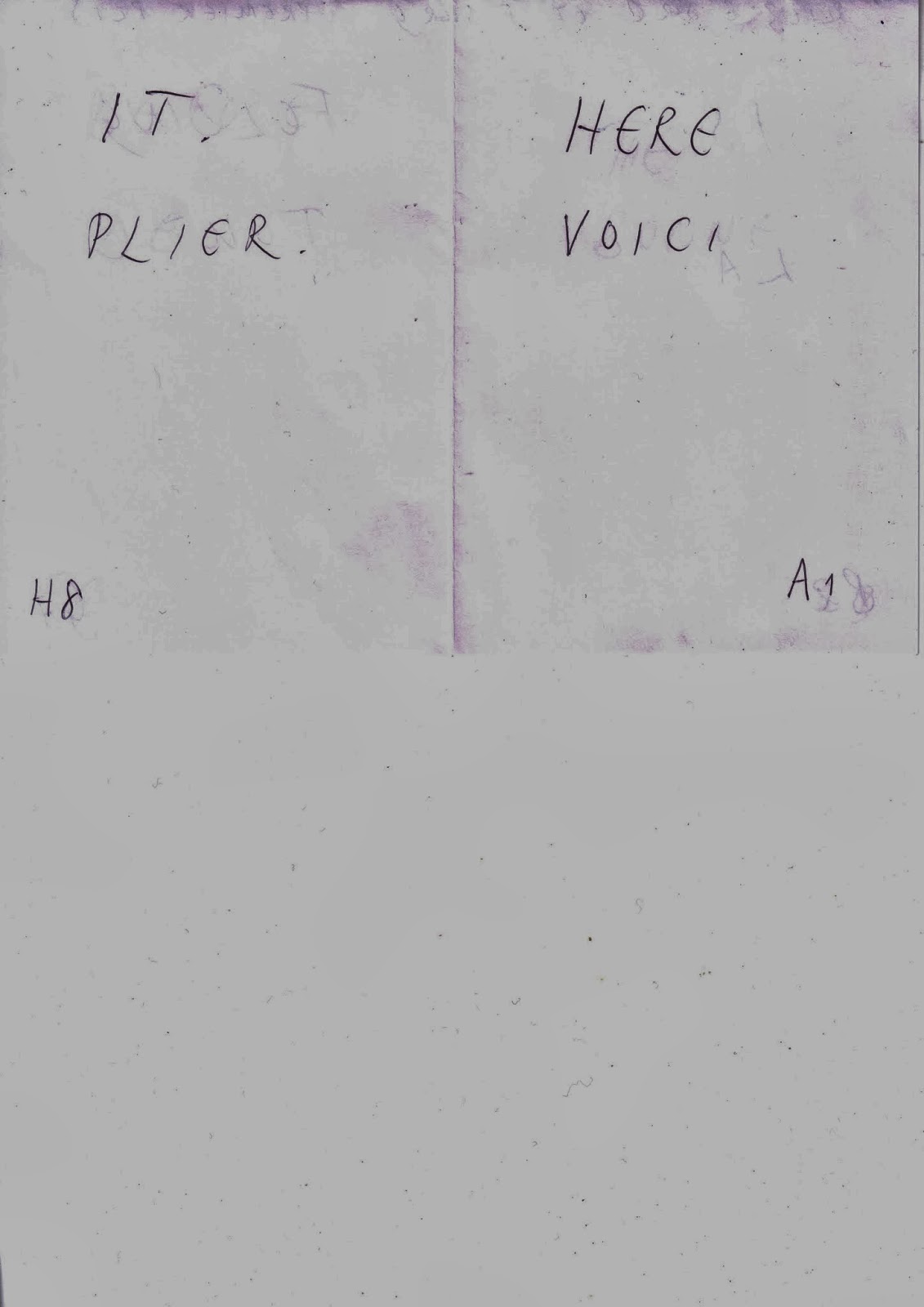
|
| New infold after first fold |

|
| English text/Texte français |
| Here is the right position before folding it. |
| Voici la bonne position avant de tout plier. |
Subscribe to:
Posts (Atom)
